

- HOME
- The Background of Open Access
The Background of Open Access
Methods for Making Papers Open Access
Types of Open Access
| Green OA | Green OA refers to a route to Open Access in which authors deposit their research outputs in an institutional repository or another open repository (self-archiving), making them freely available to the public. The version that may be deposited (e.g., the author's accepted manuscript or the publisher's version) and the timing of public release are often subject to publisher or society policies. In some cases, an embargo period must pass after publication before the work can be made openly accessible. Our university operates the Nagoya Institute of Technology Institutional Repository. |
|---|---|
| Gold OA | Gold OA refers to a route to Open Access in which an Article Processing Charge (APC) is paid to make a scholarly work openly accessible immediately upon publication. This model is commonly used by Open Access journals and hybrid journals. Gold OA provides immediate public access to research articles and data, thereby enhancing their visibility, accessibility, and potential impact. At the same time, the increasing cost of APCs has emerged as a major challenge for researchers, institutions, and funding organizations. Our university provides support for APCs.
|
| Diamond OA | Diamond OA is a scholarly publishing model in which research outputs are made openly accessible without fees for either authors or readers. Publication costs are supported by research institutions, public funding bodies, publishers, scholarly societies, or other organizations, rather than through APCs paid by authors. |
| Bronze OA | Bronze OA refers to scholarly works that are made freely available on a publisher’s website without a clear statement of reuse rights or an open license. Access may be provided free of charge, but the availability of the content may be temporary. |

How to Make Your Paper Open Access via Green OA
- Depositing works in the Nagoya Institute of Technology Institutional Repository
The Nagoya Institute of Technology Institutional Repository was established in March 2008 and has been available through the JAIRO Cloud platform since March 2017.
For details on the submission of journal articles and other scholarly outputs to the repository, please visit the page below. - Depositing works in external repositories or preprint servers
Research outputs can also be made openly accessible by depositing them in subject-specific repositories or preprint servers that allow authors to share manuscripts prior to peer review. These platforms provide a means of disseminating research widely and achieving Open Access outside traditional publishing channels.
How to Make Your Paper Open Access via Gold OA
- Submit to an open-access journal
- Submit to a hybrid journal
Our Institute offers discounts and support for APCs.
Click Support for Article Processing Charges (APCs) for more details.
Publication through Japan Institutional Gateway (JIG)
The Japan Institutional Gateway is a platform where researchers based in Japan can publish their research findings (in both English and Japanese) in an open research format. All research outputs on this gateway are published as open access, making them freely accessible to anyone. The platform adopts the F1000Research publishing model, which combines the advantages of preprints (rapid publication without editorial bias) with mechanisms that ensure quality and transparency (invited open peer review, archiving, and inclusion in bibliographic databases).
When papers are submitted to JIG, they are tagged in Google Scholar, and after passing peer review, they are indexed in many databases including Scopus and PubMed. The platform was originally operated by the University of Tsukuba as “F1000 Research University of Tsukuba Gateway.” In August 2022, however, it was relaunched as the JIG to expand access to other universities, now supporting publications in Japanese. NITech joined JIG at the end of fiscal year 2023 to provide an additional option for making research outcomes open access. Any researcher at NITech can submit their papers and other research outputs to JIG.
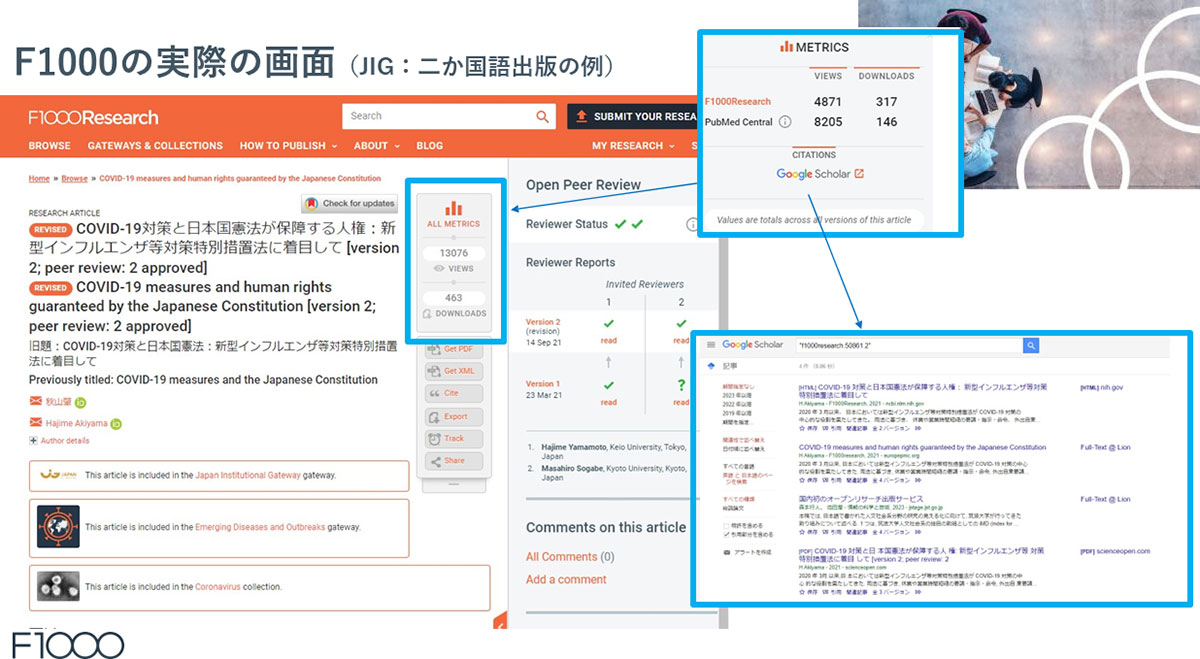
How to Submit Papers to JIG
Nagoya Institute of Technology Open Access Policy
Nagoya Institute of Technology established its Open Access Policy on September 4, 2024, with the aim of broadly disseminating intellectual achievements produced by all those involved in research at the Institute—including faculty members, technical staff, graduate students, and undergraduate students (hereinafter referred to as “faculty members, etc.”)—to contribute to the development of research and education as well as to society. Under this policy, faculty members and others at NITech can either make their academic papers published after the policy’s establishment open access or declare when this is not possible.
- Nagoya Institute of Technology Open Access Policy
- Nagoya Institute of Technology Open Access Policy Guidelines
Creative Commons License (CC License)
What is a Creative Commons License?
Creative Commons (CC) licenses are a set of standardized copyright licenses designed for the digital age. They enable creators to indicate how others may use their works by specifying conditions under which the works may be shared, reused, or adapted.
By applying a CC license, creators can retain copyright while allowing their works to be distributed more widely. Users may copy, redistribute, remix, transform, or build upon the licensed work, provided they comply with the terms of the applicable license.
Types of Creative Commons Licenses
Creative Commons licenses (Version 4.0) are available in six different types, based on combinations of four license elements: Attribution (BY), NonCommercial (NC), NoDerivatives (ND), and ShareAlike (SA). These elements allow creators to specify how their works may be reused, shared, and adapted by others.
For more details on CC licenses, please see “What Is a Creative Commons License?”
Predatory Journals
Some Open Access journals operate primarily to collect high APC while providing inadequate—or, in some cases, no—peer review. Such journals are commonly referred to as predatory journals.
Publishing in these journals may result in a range of disadvantages, including reduced visibility, diminished credibility, and limited recognition of research outputs. Researchers should therefore exercise caution when selecting a publication venue.
At the same time, it is often difficult to determine definitively whether a particular journal or publisher is predatory, as journal quality exists on a spectrum and may change over time. Before submitting a manuscript, authors are encouraged to carefully evaluate factors such as the quality of published articles, the composition of the editorial board, the transparency and rigor of the peer-review process, and the journal’s overall reputation. Careful assessment of these factors can help authors identify trustworthy publication venues.
Publishing in predatory or low-quality journals may negatively affect your reputation and credibility as a researcher.
- Damage to the reputation and credibility of the author and their affiliated institution.
- Inability to withdraw the manuscript after submission, preventing its submission to another journal.
- Unexpected requests for high APCs.
- Loss of access to the published article if the journal or its website ceases operation. etc.
Tools for verifying the credibility of journals
- DOAJ(Directory of Open Access Journals)
A directory of Open Access journals. DOAJ is a free database that allows users to search for Open Access journals and includes only journals that have undergone a review process for inclusion. - Web of Science:Master Journal List
A free tool that allows users to search for journals indexed in Web of Science, one of the world's largest scholarly literature databases.
A tool for Evaluating Journal Credibility
- Think Check Submit
A resource that helps researchers evaluate the credibility and trustworthiness of journals by following a checklist before submitting their manuscripts.
- HOME
- The Background of Open Access